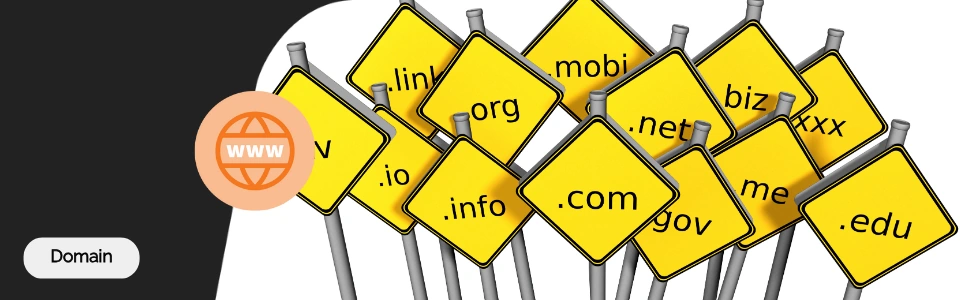
We’ve already covered domain names in several of our blog articles, including how to choose the right one or learn about the benefits of domain extensions. Now, let’s go back to the beginning and introduce the different types of domains.
What is the domain?
A domain name is the address we type into a browser when visiting a website. For example, dotroll.com is a domain name, where “dotroll” is the so-called second-level domain (SLD), and “.com” is the top-level domain (TLD).
Domain names were created to replace IP addresses (e.g., 192.168.1.1) with easy-to-remember names for accessing websites. Today, there are millions of registered domain names worldwide, and more and more new extensions are becoming available.
Top-Level domains (TLDs)
The URL of each website has different parts; in the case of our website, the top-level domain at dotroll.com is .com. There is also a growing need for custom domains when a particular TLD runs out of capacity. It is a collective group of several types.
1. ccTLDs (country code top-level domains)
cTLDs are associated with individual countries. Examples include:
.hu – Hungary
.de – Germany
.fr – France
.uk – United Kingdom
These domains are generally available to companies and individuals registered in the respective country and are often subject to national regulations. You can find information about the specific rules associated with each domain extension in the domain extension database.
In Hungary, the most popular extension is, of course, .hu. On the registry’s website, you can follow the changes in the number of registrations through a graph: https://info.domain.hu/stats/hu
🔍 Tip: Use the domain search tool to easily check whether a given ccTLD is available.
2. General top-level domains (gTLDs)
Some of the most well-known domain extensions include:
.com – “commercial,” originally for business use; the most popular extension
.org – for non-profit organizations
.net – originally for network providers, now available for anyone
.info – for informational websites
gTLDs are open to everyone, and today, hundreds of different versions are available. Since 2015, many new, topic-specific extensions have been introduced, such as:
.blog | .online | .shop | .tech |.photography
These allow the domain name itself to reflect the website’s content. In our offering, you can choose from hundreds of extensions, giving you a vast range of options.
Previous collections:
Environmental domain – infographics
Domain extensions in art topic – infographics
Domain for services – infographics
Our favourite domain extensions in the food-drink topic
Unique domain extensions for webshops – infographics
[Prices in our previous collections may not be the latest, so if you’re interested in one of the domain extensions, check the latest price in our domain extensions database.]
3. sTLD, the sponsored top-level domain
sTLDs target specific audiences and are generally regulated. Examples include:
.edu – only for educational institutions (mainly in the USA)
.gov – U.S. government agencies
.mil – military organizations
.museum, .aero, .jobs – for specific industries
These domains are not available to everyone and often require proof of eligibility.
4. GeoTLDs
geoTLDs are TLDs associated with geographic locations. Examples include:
.berlin | .london | .tokyo
Their purpose is to strengthen local identity or promote tourism and business presence.
Second-level domain (SLD)
The SLD (Second-Level Domain) is the part of the domain name that comes before the dot — for example, “dotroll” in dotroll.com.
This is the identifier that visitors remember, so choosing the right one is crucial. Brand relevance, brevity, uniqueness, and easy memorability are all important factors.
💡 Tip: It’s a good idea to come up with the SLD first, then find the domain extension that best matches it. When choosing the extension, also consider the target audience of your future website!
Premium domain names
Premium domain names are short, common, or keyword-rich domains that have already been registered and are sold at a premium price. Their characteristics include:
The list of premium domains varies in quantity and price across different extensions. These domains can often cost hundreds of thousands or even millions of forints due to their high business value. However, in some cases, the investment is worth it — especially if the domain includes a keyword that is important from an SEO perspective.
Second-level public subdomains
Second-level public subdomains include for example .co.hu, .konyvelo.hu, .bolt.hu or .utazas.hu, which domains are already registered, but we may require domain registration. If you want to register the mintawebshop.hu, but this domain isn’t free, you can choose the mintawebshop.bolt.hu domain instead. You can view the list of second-level public subdomains on domain.hu.
More popular “alternative” ccTLD-s
Although technically country-code extensions, some ccTLDs have gained global popularity:
.io – originally for the British Indian Ocean Territory, now a favorite among tech companies
.tv – Tuvalu’s domain, but widely used by video and streaming platforms
.me – Montenegro’s domain, perfect for personal branding
These extensions are globally available and are often given thematic meanings within specific industries.
How to choose the perfect domain name?
Use the domain search tool to instantly check whether your chosen domain name is available. It’s worth searching for multiple extensions and considering the following:
-
How short and memorable is it?
-
Does it contain a keyword?
-
How well does it represent your brand or activity?
-
Is the name available on social media platforms?
Summary
A domain name is more than just a web address — it’s the foundation of your online brand. The wide variety of top-level domains (TLDs) gives you the opportunity to choose an extension that fits your business, target audience, or even geographic location.
Take advantage of these options, and don’t be afraid to experiment with new, thematic TLDs!